
Consciousness
First, per Chalmers (1995), we divide the consideration of consciousness into two sub-problems, which he termed the hard and easy problems. The hard problem is concerned with how it feels to experience consciousness, i.e., qualia, and this problem is beyond the scope of objective understanding because it is fundamentally and inevitably subjective in nature. Each individual person experiences their own qualia because they are their brains, and only one individual can have an identity relationship with their own brain. An outside observer is just that: someone who can see things from outside that brain, but that perspective will never provide the intimate view from the inside out, which only the brain itself can have.
The remaining easy problems of consciousness have to do with all of the aspects of it that are amenable to objective understanding. Perhaps the most basic such question is, under what circumstances do humans report experiencing conscious awareness, and can we use this information to understand more about the neural correlates of consciousness (NCC)?
From my perspective, there is general consensus involving terms like global workspace (Baars, 1988; Dehaene & Naccache, 2001 and integrated information (Tononi, 2004) used to describe an ability to integrate the different parts of the brain so they are all working together in some kind of coordinated and unitary way. Subjectively a key feature of conscious experience is this unitary sense of attentional focus on a specific thought or experience at each moment in time, which these frameworks seek to address.
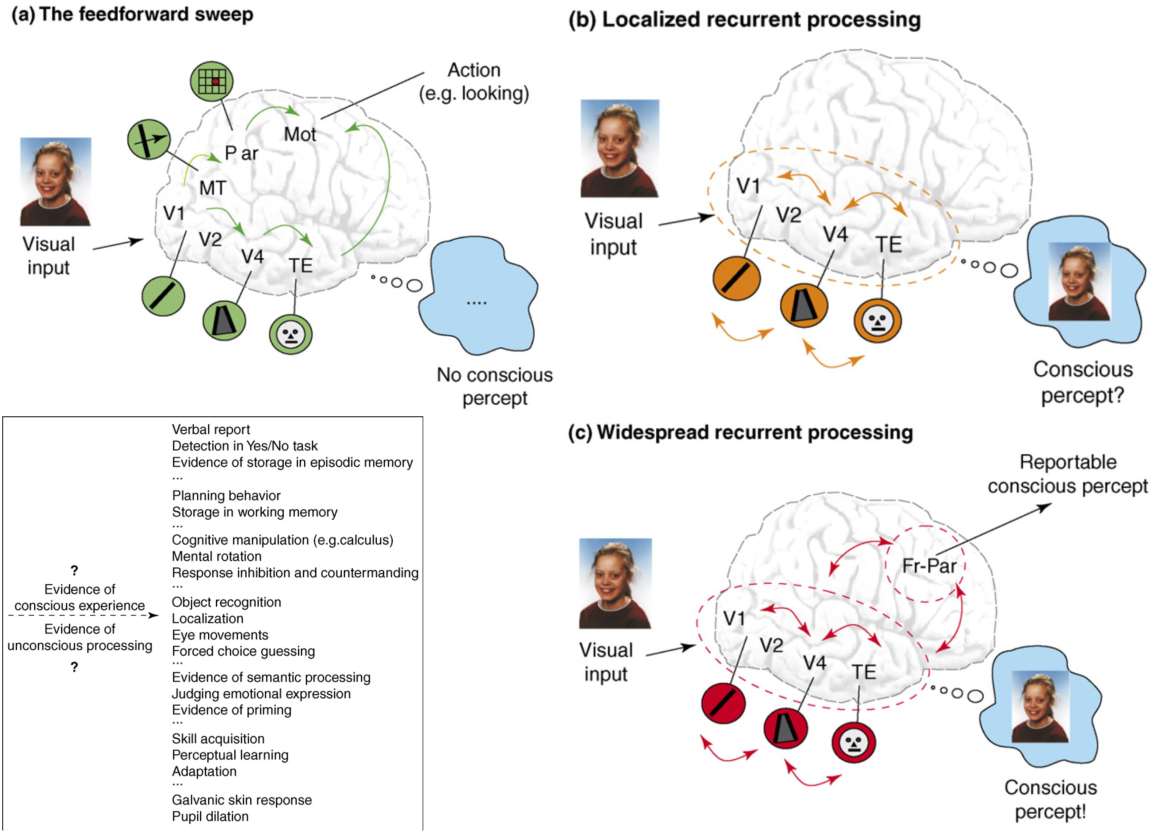
Figure 1: Consciousness is associated with robust recurrent processing across wide areas of the neocortex (Lamme, 2006). (a) With just the initial +feedforward sweep of neural activity going from primary visual cortex (V1) on up, people generally do not report subjective, conscious awareness. (b) When more time has passed and +bidirectional, recurrent connections can drive activity back down through these same visual areas, people are more likely to report conscious awareness. © With even more recurrent processing across more widespread areas of cortex, corresponding to something like a “global workspace” of coordinated activity, conscious awareness is strongly felt. Thus, the degree of recurrent processing provides a good measure of the graded strength of consciousness.
Perhaps the most neurally explicit theory along these lines is that recurrent processing in the brain is necessary for the integration aspect of consciousness (Lamme, 2006) (Figure 1). Recurrent processing depends on recurrent connectivity, where neurons in different areas have bidirectional connections (area A excites area B, and B also sends excitation back to A).
Recurrent connectivity enables two areas to engage in a bidirectional “conversation” to coordinate their “thoughts”, in much the way two people talking in a bidirectional, interactive way can achieve mutual understanding and sharing much more effectively than if one person is just blasting the other with a one-way download. Interestingly, recurrent connectivity is is almost exclusively found in the neocortex, and there is considerable evidence that we are exclusively conscious of neural activity in the cortex: neural activity in subcortical areas such as the cerebellum or basal ganglia remains subconscious (Koch et al., 2016).
This recurrent processing framework connects the biological and phenomenological aspects of consciousness, explaining why conscious experience involves widespread coordination among multiple brain areas, enabling them all to work together on whatever you might be thinking about at the moment. Together with the related global workspace ideas, there is a clear picture of the functional benefit of consciousness too, consistent with the intuitive benefits of really focusing your entire brain on one thing: each different brain area can then contribute its own “expertise” to the overall situation, and the bidirectional coordination means that these contributions can converge to help shape the overall trajectory of your stream of conscious thoughts, providing a “more than the sum of its parts” level of cooperative functionality, just like when a team of people is working together really well.
This framework also helps to address the many philosophical zombie arguments that philosophers are fond of making: the idea that you could have something that works identically to the human brain in all objectively measurable ways, but just lacks the spark of consciousness. This is indeed one of the lines of argument that Chalmers makes in trying to motivate the dualistic nature of the “hard problem” of consciousness, separating it from all the easy problems that would be objectively present in a fully functioning human. However, if these unitary, coordinated, recurrent aspects of human brain function are actually essential for making it work in the first place, then you really cannot have the kind of zombie version of it that the philosophers envision.
Interestingly, the various LLM (large language model) AI systems (e.g., Brown et al., 2020) provide a direct test of this philosophical zombie argument, in that they can perform many of the same cognitive functions as the human brain, and yet not many people are willing to ascribe conscious awareness to such systems. Do they have qualia? It seems unlikely. Perhaps not coincidently, these systems lack the kind of full bidirectional connectivity present in the human brain.
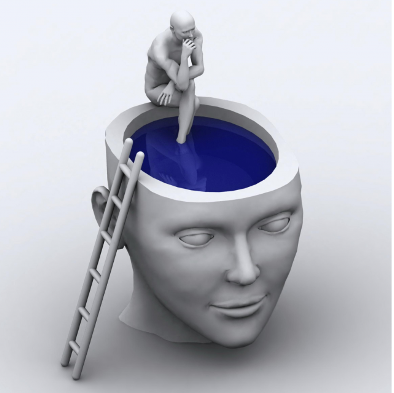
Figure 2: Illustration of the concept of metacognition and self awareness, where we are able to access our own internal mental states and use them for further decision making or processing. We know what we know and, critically, what we don’t know, so we can figure out what we need to figure out! This meta level of self-awareness is central to our subjective sense of consciousness, and depends on massive recurrent connectivity to enable our own internal states to be accessed broadly.
An important capability that is enabled by recurrent processing is metacognition or self awareness, where the system can directly access its own internal states and use that information as a basis for further decision making or processing (Figure 2). This is a powerful cognitive tool that is otherwise missing in systems without bidirectional recurrent connectivity, and it reinforces the idea that consciousness is not just an interesting sideshow in the theatre of the mind — it is the main stage upon which our most advanced cognitive abilities depend.
Note: the above material is adapted from my intro psych textbook.