
Mysticism
Mysticism refers to a range of different religious traditions that generally share certain common features (see the Wikipedia page for details and controversies), including a focus on some form of “awakening” or unity with God. Examples include Buddhism, Sufism, Kabbalah, and various other forms of spiritual practices. This awakening results in a heightened awareness of the way one’s own mind works, within the general framework that God lives within each human soul, so achieving this unity with God means achieving a unity with one’s own mind.
It is interesting to try to understand the nature of these traditions within the context of our current scientific understanding of brain function, as a way of enriching that scientific understanding, and also de-mystifying the otherwise mystical nature of these traditions. Presumably adherents of these practices would not be so excited about the latter goal, but anyway, we’re objective scientists here, so that’s what we like to do!
One common foundation across multiple traditions is the importance of being able to move beyond more “basic” everyday needs, to create the mental space needed to contemplate the “big picture” questions (e.g., “looking through the eyes of God”). Another is a strong focus on specific leader / follower relationships and associated potentially lengthy training that is required to accomplish the mystical goals. Indeed, the root of the word mystic derives from the Greek term for initiate / instruct, and the general idea is that there are these powerful mysteries that only “enlightened” people know, and you have to go learn everything from these special teachers.
Both of these aspects fit well with the nature of motivation and emotion in the brain, and in particular the central role of social motivation and cultural learning.
Overall, mystic traditions are squarely in line with the grey philosophy, because they embrace and reflect many contradictions, while seeking a higher level of understanding where these contradictions are somehow resolved into a coherent framework. For example, a central principle is the need for emotional detachment, to free the mind. But emotional detachment also short-circuits the motivational system: our emotions are the engine of motivation. Thus, the challenge is to somehow achieve a strongly motivated yet emotionally-detached state: the grey zone.
This issue is particularly manifest in the social motivational space and associated social dynamics involved in mystic traditions. How can you be mentally free and responsible for your own mental state, if you are just following a leader’s instructions? Among peers, how can you somehow share the strategies, thoughts, and emotions that you find so important, without activating strong social emotions like competition, jealousy, hurt, and the ever-present resistance to perceived attempts of others to control your behavior? This need for a sense of individual control is such a strong force, which thwarts so many well-intentioned attempts to help others. If someone voluntarily subverts their own need for control and follows a leader, that might allow some progress, but at some point the training wheels need to come off, and what happens then?
The concept of ego (nafs in the Sufi tradition) is central to the above issues. Ego in the social context reflects the desire for respect and autonomy from the control of others: effectively to be at a relatively high social rank so that you have a sense of social freedom. But the explicit goal of the training in these mystical traditions is to stamp out the ego, for example by forcing inductees to perform ardous menial labor under the unrelenting command of a more senior person. Basically boot camp for Buddhists.
The synthesis that reconciles these apparent contradictions is the notion that by enduring and finally succeeding in these clearly difficult challenges that go against our natural instincts (i.e., by truly letting go of your ego), you then attain a high social status of respect, because you have demonstrated rare strength and character by so doing. Critically, you get this respect even though you’re not attached to it or really trying to obtain it — indeed, quite the opposite. That is the difference between a normal “high ranking” member of society who works hard to establish and maintain their position, and the ascetic monk or dervish who obtains respect by explicitly ignoring all those social norms.
Another important aspect of the ego that needs to be broken down is all the thought processes shaped by cultural norms and lived experiences, that prevent people from having more direct access to their own motivational states. Our brains are wired to be goal-focused predictive learning machines, which means that we are always thinking about the future, which requires incorporating salient experiences from the past (e.g., ruminating about past events in relation to future plans). When people’s brains are scanned while just lying in a brain scanner, this is the “default mode” of brain function. It often intrudes into other tasks too (e.g., “daydreaming”).
While this is all highly adaptive for survival, it prevents one from living in the present moment and understanding what is actually happening inside our own brains. The meditative, mindfulness elements of mystic traditions are critical for developing an awareness of these patterns of thought, and ways of gently steering things to be more focused on this ever-elusive present moment.
In summary, according to many of these mystic traditions, to gain enlightenment you must first lose everything that you’ve worked so hard to develop over the course of your life: your social standing, your excellent survival skills and ability to anticipate and manage all manner of challenging real-world situations, especially in the context of the social world. You must take major risks and suffer the loss of everything dear to you, and only then will you enter this higher plane of existence. And somehow you must have faith that by suffering so, you actually will end up in a better place in the end. See Randy’s journey below for an alternative path that nevertheless shares some of these elements.
Another element of the synthesis is to recognize that certain motivations such as curiosity and love (social inclusion) are generally safer on the pathway to enlightenment, leading to greater understanding and positive social interactions. Thus, these traditions focus on finding ways to orient one’s motivational systems around these needs, while avoiding the other more negative ones.
Needs and attachments
One of the core elements of Buddhism is that the path to nirvana (an enlightened state) requires letting go of attachments to more basic emotional drives, which are the cause of endless suffering. For example, being obsessed with making more money or seeking hedonistic rewards may seem to provide happiness, but ultimately this is a trap because these drives are insatiable.
This insatiability is driven in part by the dopamine system in the brain, which has neural mechanisms that learn to expect whatever level of reward you are receiving. This learning is adaptive by enabling the brain to adjust to different circumstances, but insatiability is an unfortunate side effect of this adaptability. This gives rise to the familiar phenomenon where drug users develop higher tolerance to the drug, and thus require more to experience the same effects.
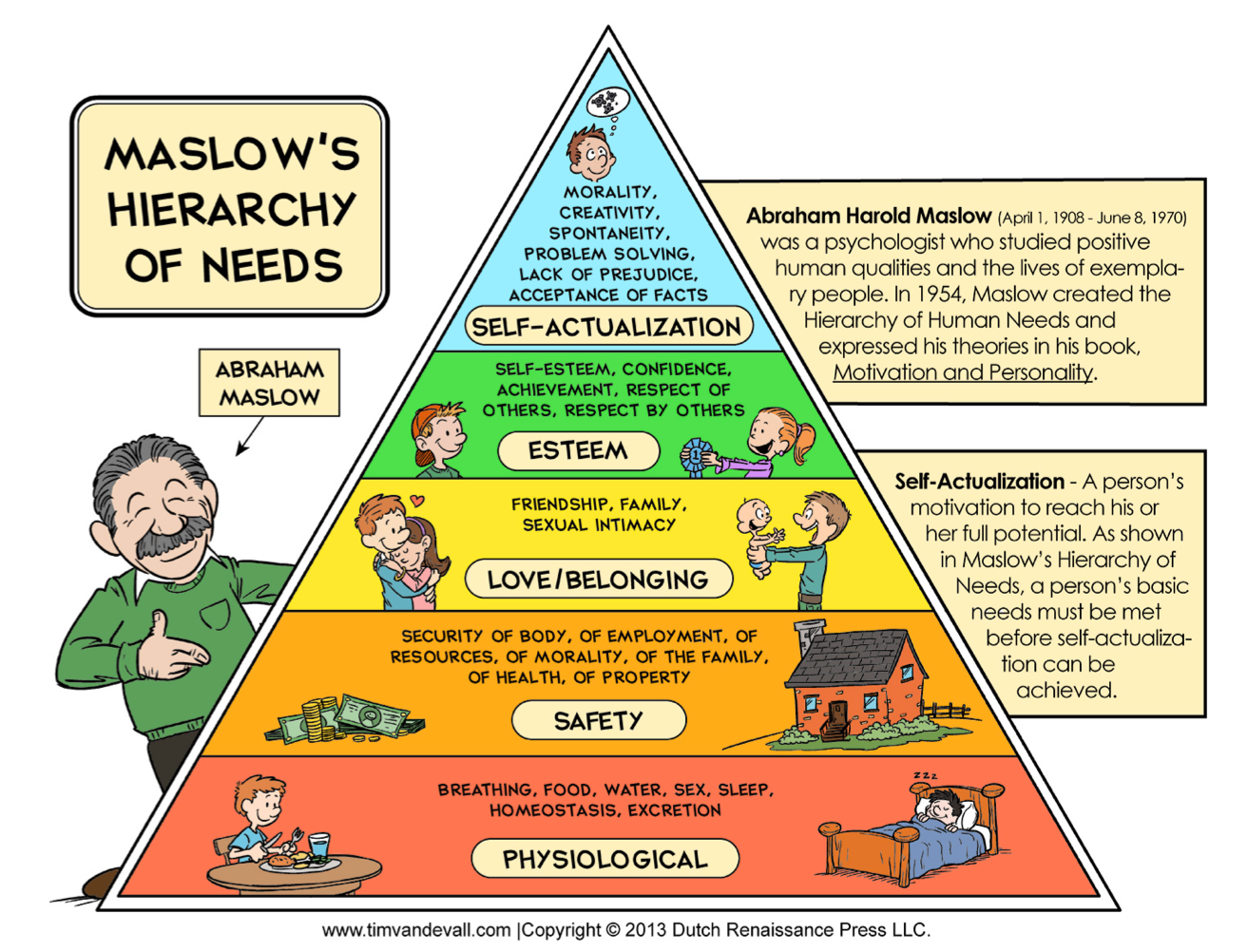
Figure 1: Maslow’s hierarchy of needs, progressing from most essential to those that gain salience once the lower-level needs are satisfied.
The hierarchy of needs developed by Maslow (1943) provides a way of organizing the various human needs into a hierarchical scheme, with the most basic survival-related drives providing the foundation, and higher-level drives only entertained once the basic needs are satisfied (Figure 1). Thus, under this scheme, only once you have satisfied your basic physiological and safety needs can you engage in social needs involving friendship, love and belonging.
The self-actualization level at the top of the hierarchy corresponds roughly to the enlightened nirvana-like state in Buddhism, with the idea that you have to fully satisfy all the lower-level needs before you can operate at this highest level of the hierarchy (Hayashi, 2016).
However, this framework does not directly take into account the possibility that someone could have plenty of availability to satisfy needs at any given level, but nevertheless remain insatiable by continuing to focus attention and effort on satisfying those needs, thus causing that level to effectively block progression up the hierarchy. Also, the brain is highly unlikely to obey a strict partitioning of needs into such levels: once you are not absolutely starving or dying of thirst, most of the other levels are likely to be exerting influence.
Control and letting go
The way in which one ends up focusing thoughts and behavior on the different levels of needs is thus the most important factor. This is where all the challenges lie, because we are often not very aware of all the forces operating within our motivational systems, and what historical and current factors are “pushing our buttons” and causing us to continue focusing on one level or another. This lack of awareness is due in part to the goal-driven, predictive-learning, future-oriented nature of our brains as discussed above: we are always anticipating and solving future problems, instead of being aware of all the forces at work in our brains in the present moment.
The brain systems involved in the motivational and emotional processes span from the lowest brainstem levels (e.g., the core survival functions of the hypothalamus) up to the highest levels of the prefrontal cortex. These areas are all mutually interconnected and interacting, and shape each other through experience-driven learning (see compcogneuro/emotion for details). Thus, as you undoubtedly have experienced, it is impossible to just sit there and “will” yourself to not care about the things that you actually do care about.
If someone has insulted you, or you’re feeling jealousy, you cannot just say “oh I’m just going to be enlightened and detached” — attempts to simply forcibly suppress these thoughts and feelings generally just lead to bigger problems accumulating over time.
This is where the Buddhist and other mystic traditions come into play, providing a comprehensive system of practices, typically under the guidance of a teacher / guru etc, to systematically shape one’s patterns of thinking and behavior, reducing the pull of the basic emotional drives, and cultivating a higher level of understanding and control over the inner workings of the emotional and motivational systems of the brain.
A key element here is meditation and mindfulness training, which develop the ability to perceive and understand the flow of your own patterns of thought, and the forces that drive them to go where they go. By recognizing all the future and past oriented thoughts that stream through your brain, and trying instead to focus on things happening in the present moment (e.g., the process of breathing), one can obtain more awareness. This greater awareness then opens up the possibility of more subtle forms of control — kind of like “surfing” the waves of consciousness rather than driving a strongly controlled top-down “dictator-like” environment (see We are all Communists for a poem on this issue).
The central and complicated role of social motivations
Figure 1 shows that, in humans, everything above the basic physiological and safety level is about social interactions. From an evolutionary perspective, the strong role of social motivations in shaping human behavior is critical for enabling people to do something beyond just endlessly satisfying basic survival needs. Interestingly, when chimpanzees were taught language, they mainly signed about food and masturbation. While this may characterize certain people you might know, fortunately there are many people that are strongly motivated to share their knowledge, and to show off amazing skills that they have thus been motivated to learn. This strong drive for sharing drives the development of culture, which is essential for lifting us out of the animalistic stupor that we would otherwise find ourselves in (Tomasello, 2001).
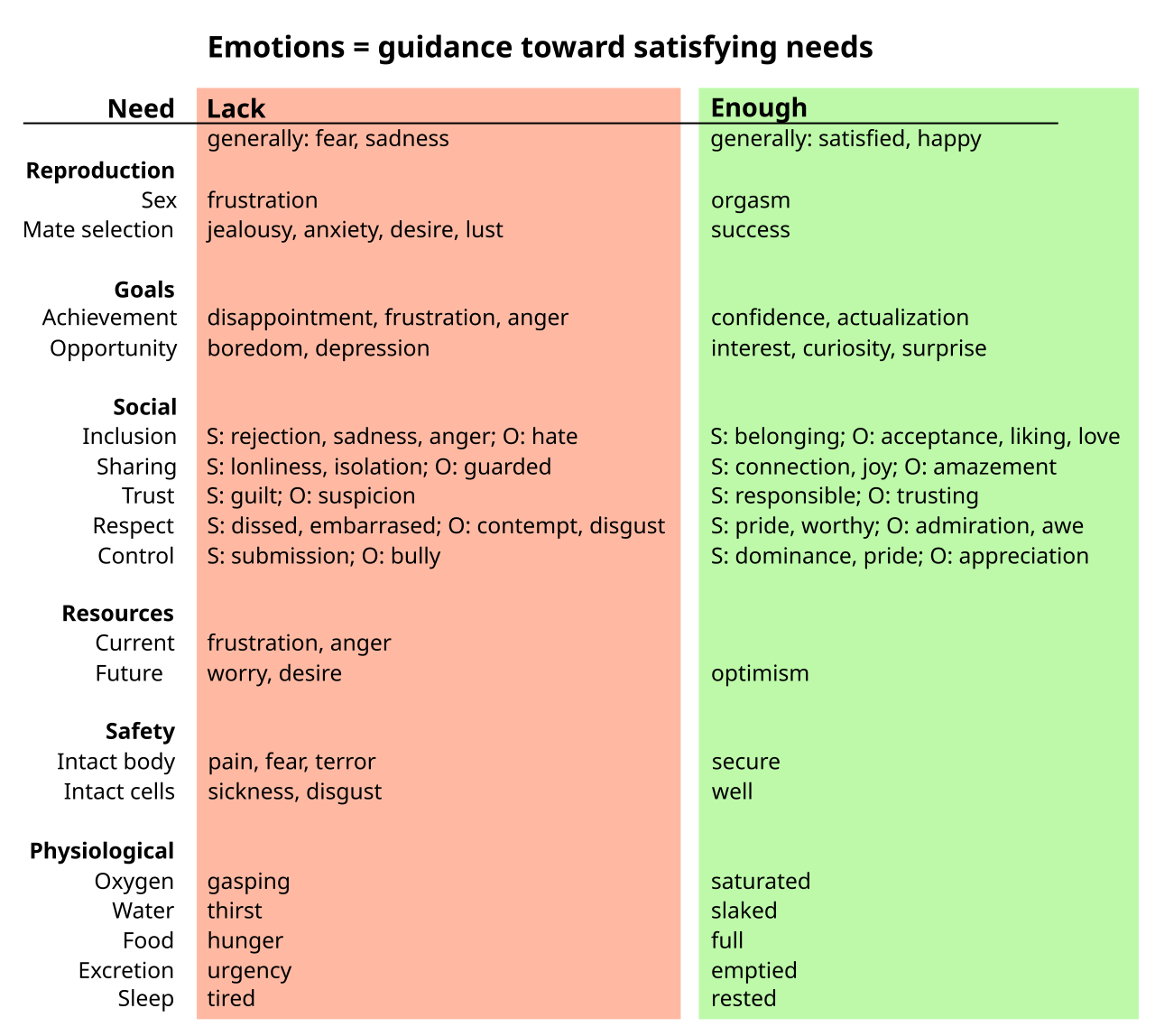
Figure 2: Emotional states as providing guidance toward satisfying needs, with a lack of need satisfaction generally driving negative emotional states, while need satisfaction drives positive ones. The list of needs is ordered with the most essential needs at the bottom, as in Maslow’s hierarchy. We don’t usually think of things like hunger and thirst as emotions, but according to this system, they play the same overall role, and share many neural substrates in common. Resources refers to any kind of material thing needed to survive in the current physical environment (money, territory, nesting material, tools, building materials, etc). The social factors include S = self perspective and O = other perspective. Most of these needs apply across all species of mammals and other vertibrates to variable extents. The social needs are particularly important for shaping flexible, open-ended human cognition.
Social motivations are powerful, but also very difficult and complex. One attempt to enumerate distinct forms of social motivation (Figure 2) includes: inclusion, sharing, trust, respect, and control. It is difficult for two people in a social interaction to each maintain the positive aspects of each of these, especially with respect to control. And when different factors go astray, it is often difficult to determine, either within yourself or in the other, which ones are at fault, and why.
Thus, the clear, unambiguous relationship between a sage-like teacher and a novice student cuts through all of those complexities, and potentially allows the teacher more “direct access” to the deeper motivational states of the student. But all of this is contingent on the student continuing to trust and respect the teacher.
There is also a strong “machismo” aspect to many of these traditions, which have historically been male-dominated. For example, this is manifest in demonstrating the extremes of who can bear the most suffering without breaking a sweat, and by having students try to work through complicated conceptual puzzles with many possible trap doors. This is consistent with the critical role of the dominance hierarchy / control factor.
Many mystical traditions focus on the concept of love as a unifying positive force. If everyone in a social interaction feels strongly included, this goes a long way toward mitigating negative effects of other social factors. In many people, the positive valence of inclusion is typically accompanied by the negative valence of hate for members of various out-groups, while love is reserved for the in-group. The negative pole here is the source of war and other examples of the most awful aspects of human behavior, while the positive pole is essential for the continued survival of the species, and is not surprisingly at the core of all major systems of religions.
Unfortunately, most religions in their orthodox or conventional manifestations strongly exhibit both the positive and negative poles of inclusion, directing hate toward members of other religions. However, most mystical traditions appear to embrace a much more universal sense of inclusion and love, with enlightenment entailing the recognition of the unity of all people despite our various superficial differences.
Thus, it is overall hard not to love these mystical traditions, which so clearly align with the values and philosophy of the approach taken here. See Shafak (2011) for an accessible and entertaining treatment of some of the central themes in the Sufi tradition, which reflects most of the issues discussed here.
Randy’s journey
My own mystical journey, if you can call it that, is documented in part through the poetry site, where you can see my unflinching attempt to confront a strong fear of mortality. I feel that this has “naturally” given me a strong sense of perspective about what matters in life and what does not. Together with my ongoing attempt to understand what the hell is actually going on in this strange planet we live on, this experience has effectively stripped me of much of my ego. How can you have an ego when you truly understand that you are basically 75% Water? Water doesn’t have an ego, why should I? I can’t even have 25% of an ego because the rest of the mass is all lipids and proteins.
I was also very lucky to have very supportive, loving parents, and so avoided inheriting any significant intergenerational trauma (so there, Philip Larkin)!
I had my first unfiltered confrontation with my own mortality at the tender age of 8, after watching the movie Cooley High (June, 1975), while my sister (with whom I was very close) was away at a bizarre Christian camp for the week (we were not at all religious). A character in the movie is beaten to death in a fistfight. The notion that death could be so close, along with my relative social isolation, sent me into a full-scale panic of the deep realization that, even if not so soon, one day I was surely going to die. I remained in this panicked state for several days.
We had moved to Southern California relatively recently, and I was very shy and didn’t have any close friends, so I had a lot of time to dwell on this. Similar such panic attacks have occurred periodically throughout my life, roughly every 10 years or so. As expressed in the Warm Bath:
Think about them once
and they engulf you whole

Think about them twice
and they extract a greater toll

Think of them always
and they let you pass
into the gates of heaven
on this great green earth.
That’s basically what I have experienced. I honestly wouldn’t call it heaven for lots of reasons, but nevertheless I do think it has given me some elements of the traditional mystical experience, and although I have periodically entered a state that I would actually say felt like nirvana, mostly I just focus on whatever is happening in the present moment and try to surf the waves of life, mindful of the importance of process vs state.